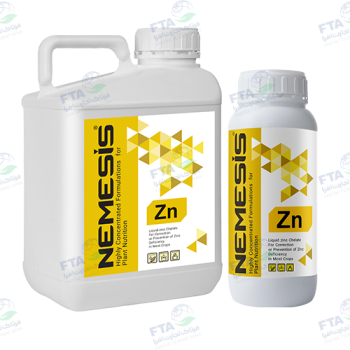

NEMESIS® Liquid Zinc
- Product Information
- Product Analyze
- Product Features
- Product Instructions
Product Name: Zn
Brand: NEMESIS
Registration Number: 72635
Form: liquid
Packaging: 1 and 5 Liters
Manufacturer: Fertak Tejarat Afra, under license from Agronutrientes Del Norte, Mexico
| Combinations | Percent (w/w) | Percent (w/v) |
| Water Soluble Zinc (Zn) | 8% | 10% |
The micronutrient element zinc in plants is involved in the formation of chlorophyll, the activation of enzymes of the protein synthesis pathway, the conversion of starch into sugar and the production of some carbohydrates, the resistance of plants against low temperatures, and most importantly, it participates in the synthesis of the auxin hormone. In case of zinc deficiency, the plants often become dwarf and the distance between the internodes decreases and the plant stops growing. In addition to these, supplying zinc to the amount required by plants increases the yield by increasing fruit buds and improving effective pollination and better inoculation of flowers.
NEMESIS Zinc fertilizer in liquid form, containing 10% zinc soluble in water, is used to prevent and eliminate zinc deficiency in the cultivation of agricultural and greenhouse plants and fruit gardens. The high efficiency of NEMESIS Zinc absorption through the leaves provides the possibility of foliar application of this fertilizer and the elimination of deficiencies in the critical stages of the need for zinc in plants. In soils with low alkalinity, NEMESIS Zinc can be applied to the roots of plants through soil application and irrigation water. Do not use NEMESIS Zinc with high phosphorus fertilizers because high phosphorus levels prevent zinc absorption and transport in plants.
| Application Method | Application Rate | Description |
| Foliar Application | 1 – 3 L/1000 L water | If needed, repeat once every 10 to 15 days. |
| Pressure irrigation | 5 – 10 L /ha | If needed, repeat 15 to 20 times during the growing season. |
| Soil Application | 5 – 15 L /ha | If needed, repeat 15 to 20 times during the growing season. |